Off-plan properties
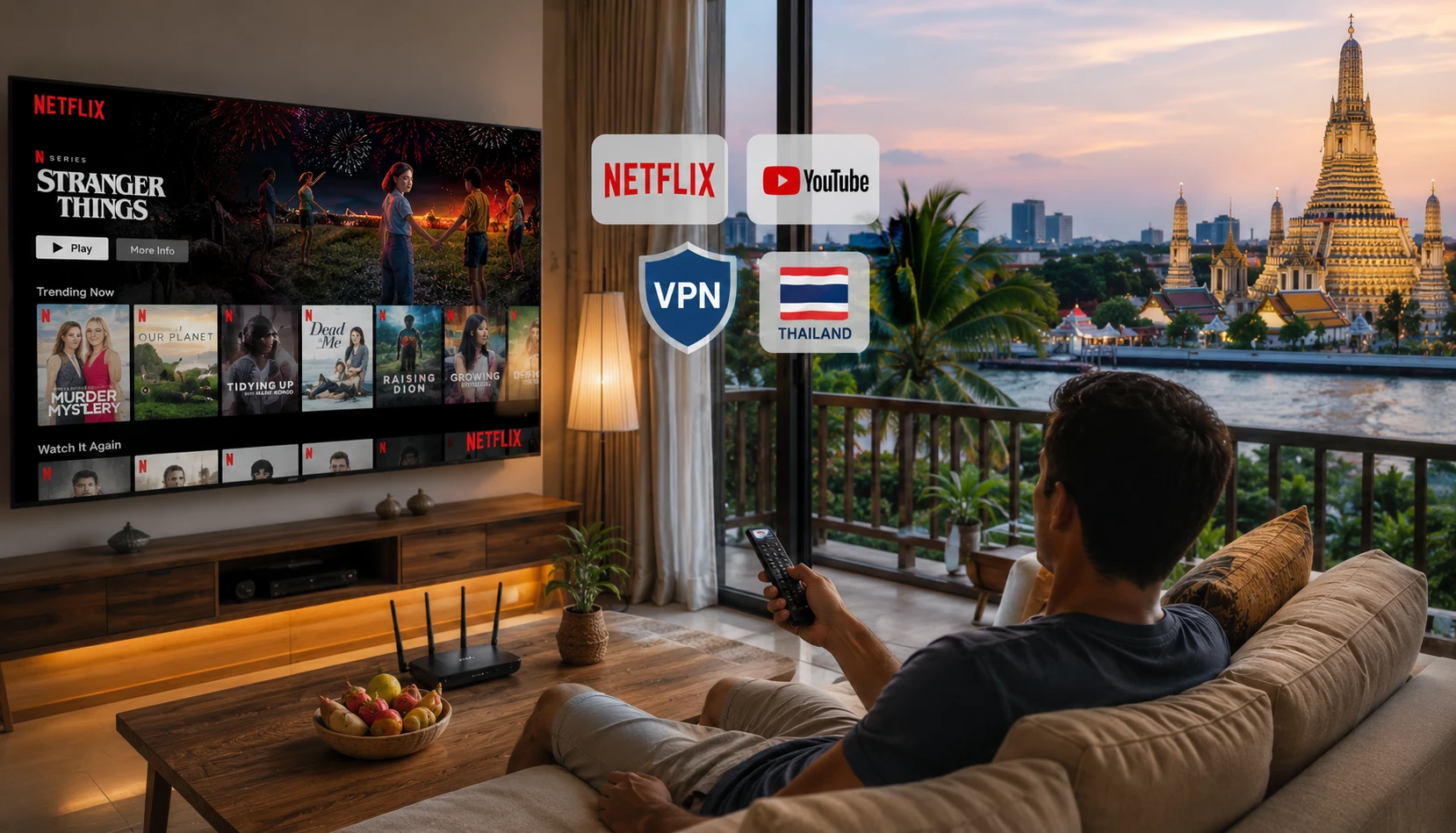
The problems people expect and the problems they get are different. Thailand does not block the major streaming services — they operate here openly, with local pricing and local apps.
What actually goes wrong is payment, account region and connection. A foreign card is declined, a library looks different from the one at home, and the film stops during a storm because the router lost power.
Below is what each of those is, how to fix the ones that are fixable and what a rental property needs to make any of it work. This article does not cover circumventing geographic restrictions, which breaches the services' own terms.
Separating them saves most of the frustration, because the fixes have nothing to do with each other:
| Problem | What it looks like | Where the fix is |
|---|---|---|
| Payment | Card declined at sign-up or renewal | Your bank, or a local payment method |
| Account region | A different catalogue from home | Licensing, mostly not fixable |
| Connection | Buffering, drop-outs during storms | The property and the provider |
| Device | App missing or outdated on a smart TV | The hardware in the rental |
Only the first and the last are genuinely in your control. The catalogue difference is a licensing matter and the honest answer is to live with it.
This is the commonest complaint and it is rarely about the service. A foreign card used from a Thai address triggers fraud checks, and some issuers block subscriptions from abroad by default.
The usual causes are ordinary: a billing address that does not match, a card the bank has flagged for foreign use, a currency the issuer declines. Tell your bank you are living abroad before the renewal date rather than after the decline. A subscription that fails to renew is sometimes cancelled rather than paused.
The stable solution for residents is a local payment method. Thai bank cards work normally with the services operating here, and several accept the local transfer systems that everyone uses day to day.
Prepaid gift cards for the major platforms are also sold in convenience stores and supermarkets, which avoids the card question entirely. Prepaid cards are also the simplest option for a stay of a few months, since they need no bank account and no address.
Libraries differ by country because the rights are sold by country. A title available at home may not be licensed here, and the reverse is equally true.
This is not a fault and not censorship. It is how content licensing has always worked, and it applies to every major platform. The Thai catalogues are large and include most international releases, plus a substantial amount of regional content that is not available at home.
An account keeps the region it was created in for billing purposes, but what you see is determined by where you are watching. Moving country changes the catalogue without changing the subscription.
Some services also limit how long an account can be used away from its registered country before asking you to update it. If you are moving here permanently, update the account address rather than leaving it. A mismatched address is the thing that eventually causes the payment failure.
For most residents the practical limit is not the platform but the internet in the building. Fibre in Thai cities is fast and cheap by international standards, and coverage in urban areas is genuinely good.
Outside cities it thins out quickly, and on islands it thins out further. The gap between a city apartment and a rural villa is larger than any difference between providers, and what to expect from the utility side of a home is set out in the breakdown of electricity, water and internet bills.
If streaming matters to you, these questions belong at the viewing rather than after moving in:
Ask to run a speed test during the viewing. A landlord who refuses has told you the answer.
This matters more than the speed. In a serviced building the connection is often the landlord's or the building's, which means you cannot upgrade it, cannot call the provider and cannot fix a fault yourself.
In a house you normally arrange your own line, which takes time to install but leaves you in control. That difference runs through many everyday decisions, and it is one of the quieter distinctions between a condominium and a villa. Find out whose name is on the account before you sign.
A brief power cut takes the internet with it, and the router does not always come back cleanly. This is the single most common interruption to an evening at home.
A small battery unit keeps a router and a phone running through a short outage for very little money. Why the cuts happen and how to see them coming is covered in the guide to power cuts and water shortages. Restarting the router in a fixed order after a cut solves most of what looks like a provider fault — modem first, then router, then devices.
Mobile networks here are fast, cheap and widely available, which makes tethering a genuinely usable backup rather than an emergency measure.
A second SIM on a different network costs very little and covers both outages and the days when the fixed line misbehaves. Streaming over mobile data eats an allowance quickly at high quality, so lower the resolution when using it rather than discovering the cap mid-film.
Rental properties come with whatever television the owner bought, and older smart TVs lose app support. An app that will not update is usually the television rather than the service.
A small streaming stick solves it for the price of a couple of dinners and travels with you between rentals. Bring your own device rather than relying on the property's, and remember to sign out of it when you leave.
Away from the cities the picture changes. Fibre may not reach the property at all, and the connection is mobile-based or a shared line serving several houses.
Speeds vary through the day, and in the wet season weather affects them. Independent arrangements are covered in the account of living off-grid in Thailand. On an island, test the connection at the property in the evening — that is when everyone else is using it too.
Thailand has its own streaming platforms alongside the international ones, and they carry regional films and series that the global services do not.
They also tend to be cheaper and to accept local payment without friction. For anyone learning the language they are more useful than the international catalogues, because the subtitle and audio options are built for exactly that.
Live sport is licensed separately and by territory, and it is where residents most often find that something available at home is not available here.
Local broadcasters hold rights to some competitions, international services to others, and the split changes between seasons. Check who holds the rights this season before subscribing for a specific competition, rather than assuming last year's arrangement still applies.
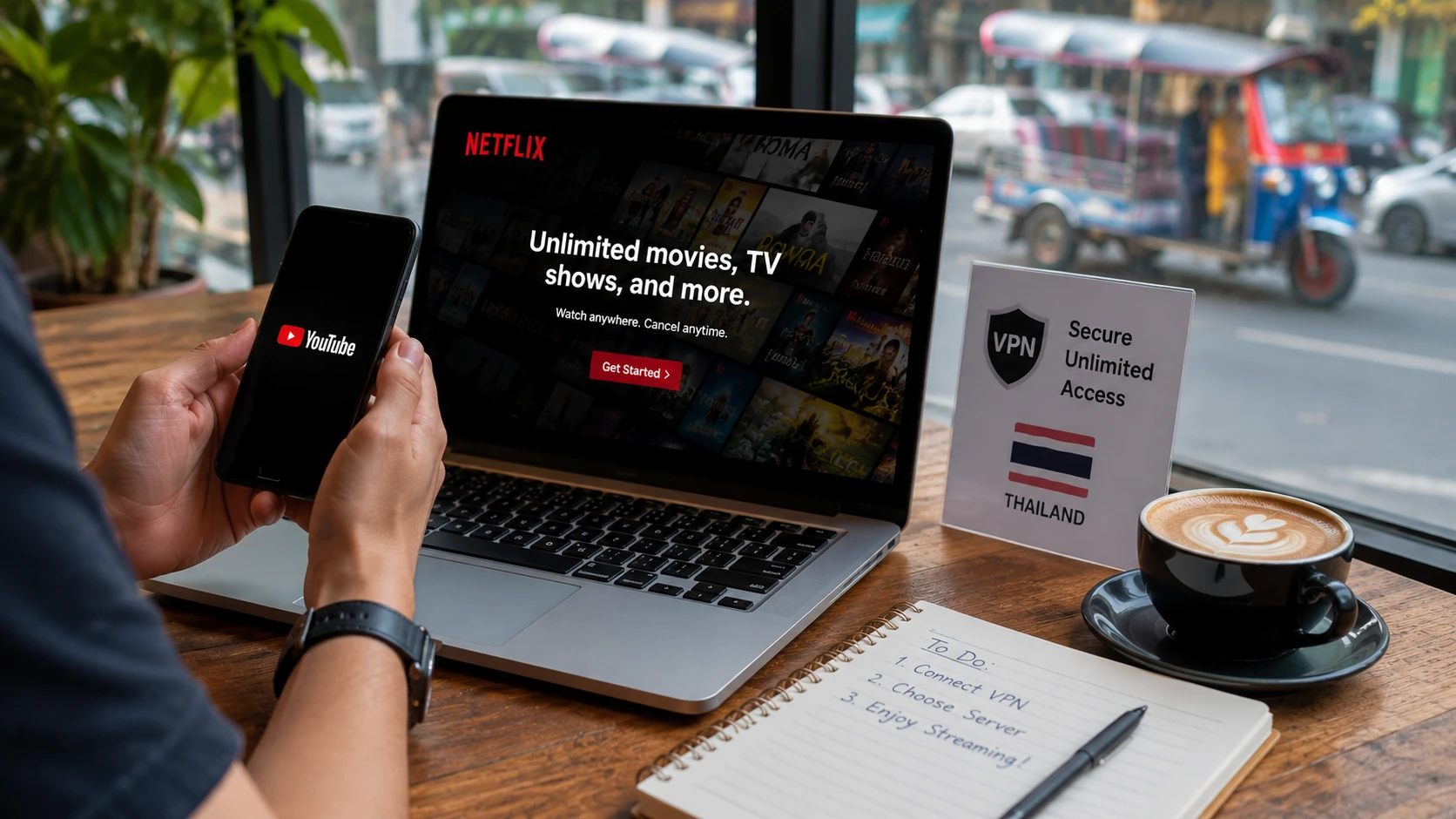
Tools that make a connection appear to originate in another country are widely discussed and widely used. Using them to reach a different catalogue breaches the terms of every major service, and accounts do get restricted for it.
That is a decision for the reader rather than advice from us. What is worth saying is that the payment and connection problems described above are the ones people actually have, and none of them is solved by that route.
Is Netflix available in Thailand?
Yes, and so are the other major services. They operate openly with local pricing and local payment options. The catalogue differs from your home country because rights are licensed by territory, which is normal rather than a restriction on Thailand.
Why was my card declined?
Usually your own bank rather than the service: a foreign transaction, a mismatched billing address, or a card flagged for use abroad. Tell your bank you are living overseas, or switch to a local card or a prepaid gift card sold in convenience stores.
Can I keep my home country account?
You can keep the account, but what you see is determined by where you are watching. Some services also ask you to update the registered country after a long period abroad, and a mismatched address is what eventually causes a payment to fail.
Is the internet fast enough?
In cities, comfortably — urban fibre here is fast and cheap by international standards. Outside cities and on islands it varies a great deal, so test the actual connection at the property rather than trusting a quoted speed.
What should I check before renting?
Whether the line is fibre, whose account it is, the real speed tested on the day, and what happens after a power cut. Whose name is on the account matters most, because it decides whether you can fix a fault yourself.
It takes two minutes at a viewing and it decides how the property feels every evening. DDA Real Estate is a real estate agency working in Thailand, and connectivity is on the list we check alongside water, power and access: whether the line is fibre, whose account it is, what the speed actually measures at the property, and what the arrangement is in a building where the connection is shared.
Look at our offers in Thailand and leave a request: we will tell you what each property is really connected to, test it rather than quote a brochure figure, and be straightforward about the addresses where working or streaming from home would be a daily frustration.