
Off-plan properties
Foreign residents usually meet Thai belief as decoration — a small ornate shrine by the driveway, garlands on a car mirror, an amulet under a shirt. It is more accurate to treat it as a working system with practical consequences, several of which attach to property.
A shrine on a plot is not an ornament the previous owner left behind. It has a position chosen by a specialist, an ongoing obligation attached to it, and a procedure for moving it that is nothing like demolition. Dates for signing and moving in are chosen rather than assumed. And a building's history can affect what it rents for.
What follows is the part of this that a resident actually encounters: the shrine on the land, the ceremonies around building and moving, why numbers and dates matter, and the everyday customs worth knowing. Practices vary by region, family and temple, so treat this as orientation and follow the lead of the people around you rather than a checklist.
Thai religious life layers Buddhism over older animist tradition, and the older layer is the one visible on the street. It assumes places have resident spirits — land, trees, rivers, buildings — and that living well alongside them is a matter of ordinary courtesy rather than of drama.
That is why the customs feel domestic rather than solemn: an offering left in the morning, a phrase said before cutting down a tree, a date checked before a move. None of it requires belief from you — what it requires is the same respect you would extend to any neighbour's practice. The general etiquette that sits on top of this, and what to avoid as a visitor, is covered in the guide to Thai cultural do's and don'ts; this article is about the layer underneath it.
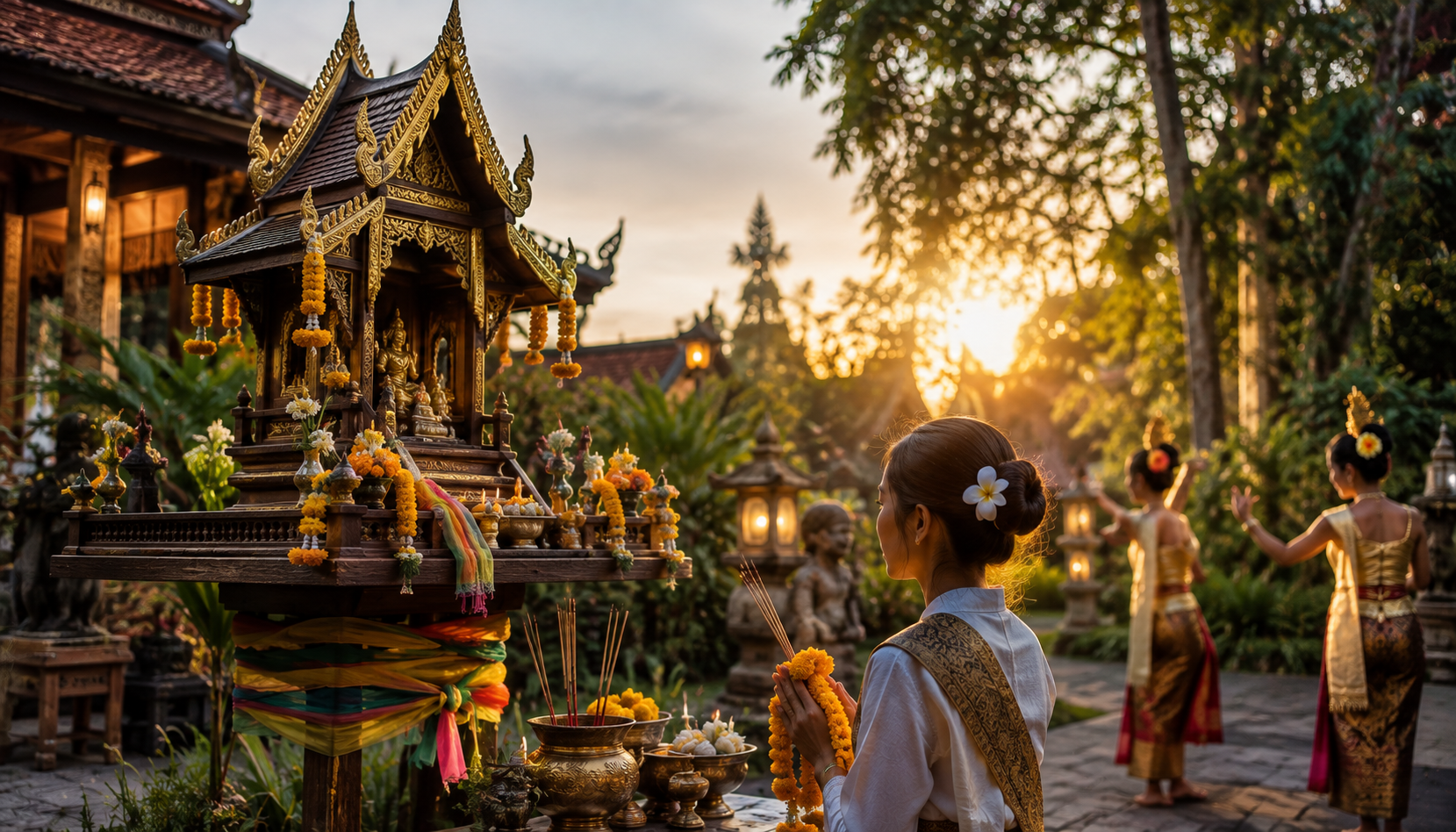
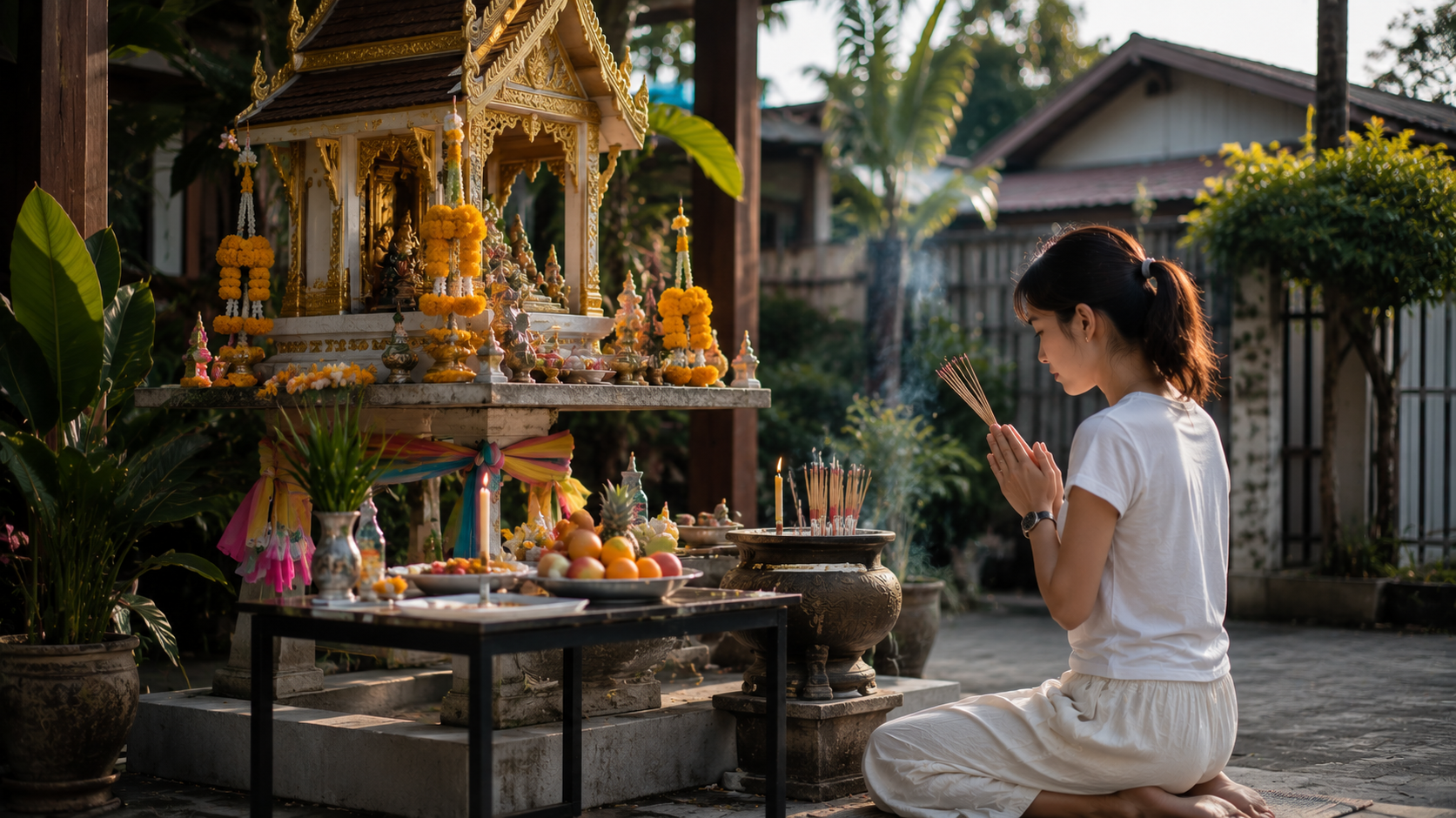
Almost every plot of land with a building on it has one: a small shrine raised on a pillar, usually near a corner of the property, where the guardian spirit of the land is invited to live so that it does not live in the house. Businesses have them too, often larger ones, and so do hotels and shopping centres.
For a foreign buyer or tenant, the useful point is that the shrine comes with the land rather than with the furniture. Whether you have one at all depends on the format you choose: a house on a plot has its own, while an apartment shares whatever the building maintains at ground level — one of the quieter differences in the choice between a condominium and a villa. What to establish before you take on a property with one:
Placement is not aesthetic. A shrine should not stand in the shadow of the main building, should not face certain features, and is positioned according to the plot and the building by someone qualified to decide — a monk or a Brahmin practitioner rather than the builder.
This matters most when you are building rather than buying. Ground-breaking is marked with a ceremony, the shrine is placed before or as the house goes up, and the schedule accommodates both. Anyone planning construction of a house in Thailand will find these steps sitting alongside the permits and the architect in the same timeline. Treat them as part of the build rather than as an optional extra — local contractors will expect it, and skipping it tends to unsettle the people you need on site.
Care is modest and regular rather than elaborate: flowers, incense, a drink, sometimes food, refreshed often enough that the shrine does not look abandoned. The particular red soft drink so often seen at these shrines has become a small national joke, but the underlying idea is simple hospitality.
A neglected shrine is read as neglect of the property generally, in much the same way an overgrown garden is. If keeping the practice is not something you want to do yourself, the usual solutions are that a member of household staff does it, or a neighbour, or that you agree with the landlord who is responsible. What is not advisable is quietly letting it fall into disrepair.
This is where a foreign owner can cause real offence without meaning to. A shrine is not moved with a trolley and it is not put in a skip. Relocation is a ceremony conducted by someone qualified, with the spirit formally invited to move, and it is arranged rather than improvised.
Disused shrines are not thrown away either — they are taken to particular places, often at the foot of a large tree or near a temple, where they accumulate in numbers that surprise visitors who stumble on them. If your plans involve removing or repositioning a shrine, raise it early with your contractor or landlord and let them arrange the procedure; the cost is small and the alternative is a bad start with everyone around you.
Weddings, business openings, house moves and sometimes contract signings are timed to dates considered favourable, calculated from the calendar and often from the birth details of the people involved. This is ordinary practice rather than an eccentricity, and it reaches into commercial life.
For a foreign buyer that means a counterparty may propose or resist a particular date for reasons that have nothing to do with logistics. It is not obstruction and it is rarely negotiable, so build a little slack into the timetable. The same logic shapes the public calendar of ceremonies and festivals — the major Thai festivals worth experiencing are the visible half of a calendar that also governs quieter, private decisions.
Numerology is a live market here, not a curiosity. Some numbers are considered fortunate and others unlucky, and the effect shows up in prices: vehicle registration plates with favoured combinations sell at auction for serious money, and phone numbers are chosen the same way.
In buildings the influence appears as floors or unit numbers that are skipped or renamed, a habit reinforced by Chinese-Thai practice where certain numbers sound like unwelcome words. The practical consequence for a buyer is small but real: a unit carrying an unfavoured number can be slower to resell in a market where a share of buyers cares, which is worth knowing when a particular unit is priced attractively for no visible reason.
Thailand has a rich and entirely mainstream ghost tradition — a staple of cinema, television and conversation, with famous figures whose shrines attract genuine devotion. Foreigners tend to file this as folklore, which underrates how much it is simply part of the ambient world.
It also has a market effect that a buyer should understand. A property where a death occurred, particularly a violent or unhappy one, can be markedly harder to let or resell locally, and may be priced accordingly. An unusually cheap property with no visible defect is worth asking about — not because you need to share the concern, but because the pool of future buyers who do share it is part of your exit.
Beyond property there is a layer of small domestic customs, held with varying seriousness depending on the household and the generation. You will encounter them mostly through other people's reactions rather than through instruction:
You are not expected to adopt any of this, and nobody will test you on it. What is expected is that you do not treat it as amusing in front of the people who hold it, and that you follow the local lead when you are unsure.
The single most useful habit is to ask rather than to assume — of a landlord, a neighbour, a member of staff. Questions asked with genuine interest are welcomed here far more readily than silent guesswork, and the answer usually turns out to be more practical and less mystical than a foreigner expects.
Do I have to maintain the spirit house on a property I rent?
Nobody will compel you, but the expectation is often there and is rarely written into the lease. Ask the landlord directly at the start. If you would rather not, agreeing that they or a member of staff continues is a normal arrangement and avoids the shrine simply being neglected.
Can I remove a shrine I do not want?
Not by yourself, and not as a demolition job. Removal or relocation is done ceremonially by someone qualified, and disused shrines are taken to particular places rather than discarded. Raise it with your contractor or landlord and let them arrange it.
Does any of this affect a property's value?
Indirectly but genuinely. A building's history, its unit number and even its orientation can influence how quickly it sells locally, because a share of the buyer pool weighs those things. You do not have to share the view to account for it in your exit assumptions.
Is it rude to decline an amulet or a blessing?
Declining politely is fine; treating it lightly is not. Accepting with a nod and putting it somewhere respectful is the easiest path if you would rather not wear it. The offence, when it happens, comes from mockery rather than from non-participation.
How much of this do younger Thais actually observe?
It varies as much as it would anywhere. Some customs are held firmly, others treated affectionately, and plenty of people are somewhere in between. The safe assumption is that the person in front of you may take it seriously, which costs you nothing.
It is a small question that tells you a surprising amount: how the property has been kept, what the landlord expects of a tenant, and whether the neighbours have been paying attention. DDA Real Estate is a real estate agency working in Thailand, and questions of this kind are part of what we check alongside the documents — who maintains what, what the neighbours and the building expect, and which local obligations come attached to a plot rather than to a contract. Foreign buyers rarely think to ask, and the answers shape daily life more than the floor plan does.
Look at our offers in Thailand and leave a request: we will shortlist properties that suit how you plan to live, set out what each one carries with it beyond the title, and be straightforward about anything that would make a place awkward to hold or to sell on.