


Off-plan properties
Losing a passport abroad feels like one problem. In Thailand it is two, and they are handled by different authorities in a specific order. Your embassy can replace the document; only Thai immigration can restore your status, because the visa or permit that lets you be in the country was a stamp inside the passport you no longer have.
That second half is what catches people. They solve the document, relax, and discover the gap at the airport — where a valid new passport with no Thai entry record is a problem rather than a solution.
Below is the sequence that works, what each authority does and does not do, why the overstay clock keeps running throughout, and what a resident has to update afterwards. Procedures, fees and processing times differ between missions and immigration offices and change over time, so confirm the current requirements with your own embassy before acting.
Getting the order right saves days, because each step needs the output of the previous one. The sequence is stable even when the details are not:
Skipping straight to the embassy is the common instinct and it costs a day, because you will be sent to get the police report first.
Before anything official, a short search is worth it: hotels and restaurants hold documents at reception more often than people expect, and taxis and ride services have lost-property procedures. Call the last three places you were before you conclude the passport is gone.
If it was in a bag with cards, contact the bank before the embassy — card fraud moves faster than paperwork does. And find your copies: a photograph of the passport page, of the entry stamp and of the visa turns every subsequent conversation from an argument into a formality. If you have none, this is the moment you will wish you did, and the last section of this article exists because of it.
This is the key that unlocks the rest, and it is obtained at a police station in the area where the loss occurred rather than wherever is convenient. The report states that you have declared the passport lost or stolen; it is not an investigation and you should not expect one.
If the language barrier is a problem — and at a district station it often is — the tourist police are the practical route, because they are set up for exactly this and work in English. Their number is one of the ones worth having saved before anything goes wrong, along with the others in the list of emergency contacts every foreign resident should keep. Ask for a copy you can keep and photograph it immediately.
Missions issue travel documents and they do it reliably, but their remit is narrower than distressed travellers assume. They will verify your identity, take the police report, and issue either a short-validity emergency document to get you home or a full replacement passport, depending on your nationality's rules and your circumstances.
What they do not do is fix your Thai immigration status, pay your bills, book your flights or intervene with Thai authorities on your behalf. Knowing that boundary in advance prevents a great deal of misplaced expectation. What to establish on the first call:
The choice matters more than it appears. An emergency travel document is fast and designed for one journey home; a full replacement takes longer but leaves you with a normal passport and a normal life.
For a resident, the fast option is often the wrong one: a single-journey document gets you out of Thailand but not back into it, and it may not support the transfer of a long-stay permit. If you live here rather than visiting, ask the mission specifically what each option means for an existing Thai permit before choosing the quicker one.
With a new document in hand, most people consider the matter closed. It is not. Your entry record, your visa and your permission to stay were recorded in the old passport, and the new one carries none of that history.
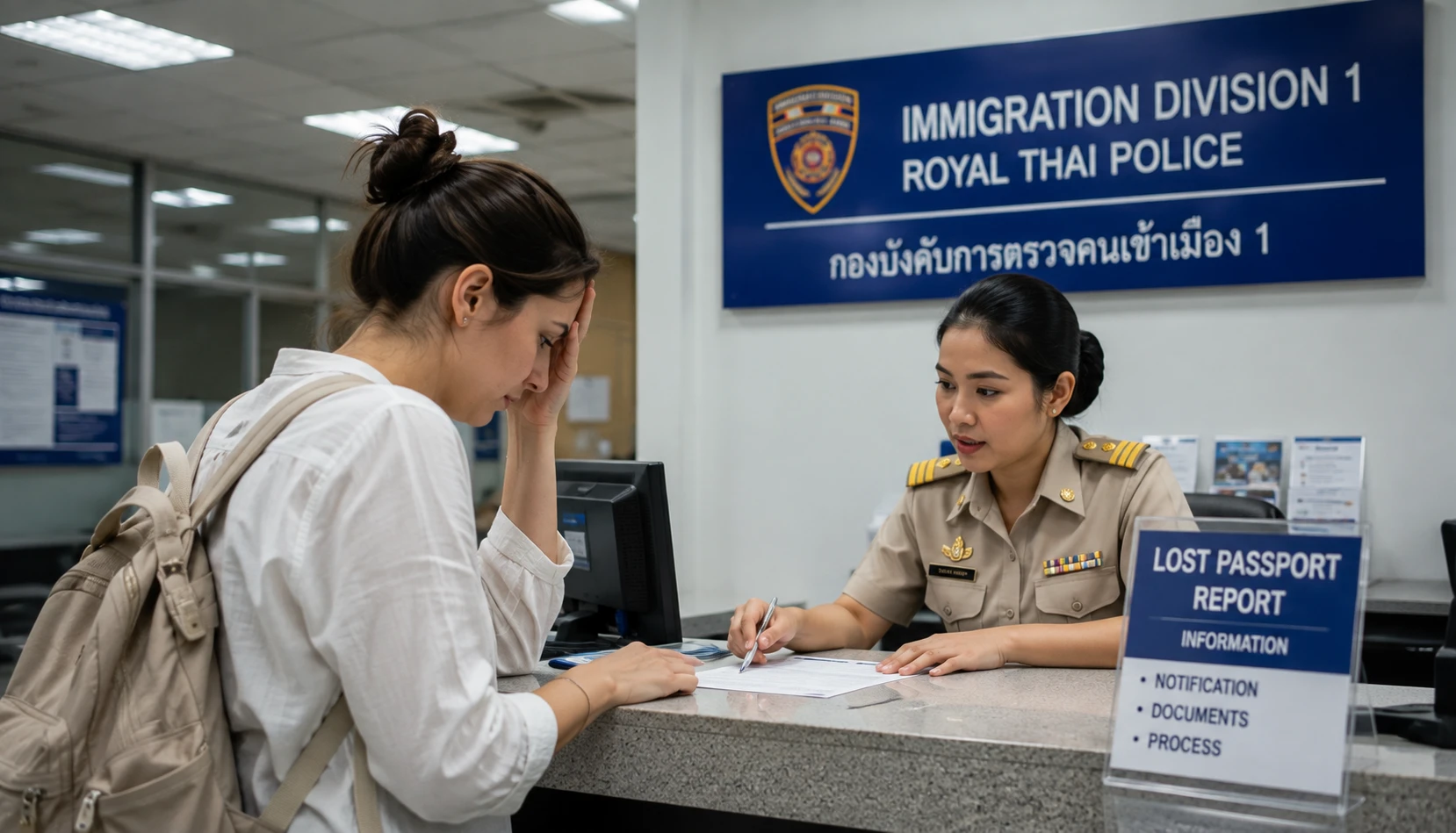
Thai immigration handles the transfer, and this is a visit you make in person with the police report, the old document's details if you have them and the new passport. Until this is done you hold a valid passport and no demonstrable right to be in the country. Dealing with these offices has its own rhythm, and the survival guide to Thai bureaucracy is worth reading before you go rather than while you queue.
This is the part that turns an inconvenience into a serious problem. The expiry of your permission to stay is unaffected by the loss of the document that recorded it. If your permit runs out while you are waiting for an appointment, you are overstaying, and the penalties apply in the ordinary way.
So the sequence is urgent even when nothing feels urgent. If the dates are tight, say so at every step — to the embassy when booking, to immigration when you arrive. An approaching expiry is a reason offices can act on; discovering it afterwards is not.
Emergency travel documents are accepted for departure but they are not ordinary passports, and the complications sit outside Thailand. Some countries do not accept them for transit, and airlines check at the gate rather than sympathetically at the counter.
Which makes the routing part of the problem:
The procedure is largely the same, with two differences. The police report matters more, because it documents a crime rather than your carelessness, and it may be needed for an insurance claim. And the identity risk is real: a stolen passport is a document someone else now holds.
Report it as stolen, not as lost, if that is what happened. Cancelling the document promptly is what prevents it being used, and both your mission and the Thai authorities record the cancellation. It also matters for the insurance claim, where a report describing a loss and a claim describing a theft is the kind of discrepancy that delays payment.
For a visitor the story ends at the airport. For someone living here it does not, because a great deal of local life references the passport number rather than your name. Every record built on the old number needs revisiting:
The residence side deserves particular attention, because so much else depends on it — how residence registration works in Thailand explains what sits on top of it, and a bank that cannot match your new document to its file will not simply let it pass, so the account rules for foreigners become relevant again.
Almost everything above is survivable and much of it is faster if you did twenty minutes of preparation on an ordinary afternoon. None of this requires effort at the moment of crisis, which is precisely when you will have none:
Can I leave Thailand with just a new passport?
Not reliably. The new document contains no Thai entry record, and departure control needs to see that you entered legally and that your permission is valid. The immigration step exists precisely to close that gap, and skipping it turns the airport into the place where you discover the problem.
How long does the whole process take?
It depends on your mission, the type of document and how quickly you get the police report. Plan on days rather than hours, and considerably longer if a weekend or a public holiday falls in the middle. If your permit is close to expiry, say so at every stage.
Do I need a lawyer?
For a straightforward loss, no — this is an administrative process. Legal help becomes worth considering if an overstay has already accrued, if the passport was involved in something else, or if your status is complicated by employment or a company.
Will this affect future visas?
A properly reported and properly resolved loss is an ordinary administrative event and should not count against you. An unreported loss, or one that turned into an overstay, is a different matter, because the overstay itself stays in the record permanently.
What if I lose it just before a flight?
Rebook rather than gamble. You will not fly on the original ticket, and the process cannot be compressed into an afternoon. Tell your airline early — a changed booking made in advance costs less than a missed departure.
Then losing it is not a travel problem, it is an administrative one that reaches into everything you have set up here. DDA Real Estate is a real estate agency working in Thailand, and this is the layer we see constantly on the property side: leases, building records and management offices all hold a copy of the same document, and when it changes, so must they. We are not the people who replace a passport, but we do help clients keep the property side of their paperwork coherent — and we say plainly when a question belongs to a lawyer or a consulate instead.
Look at our offers in Thailand and leave a request: we will set out what documents a purchase or a lease will actually require of you, what the building and the authorities will hold on file, and where the paperwork chain is worth simplifying before it becomes urgent.