
Off-plan properties
Bali is part of Muslim-majority Indonesia, yet the island's most visible religious tradition is Hinduism. Offerings appear outside homes and shops, temple processions cross busy roads, and the calendar regularly changes the pace of work and travel. Balinese Hinduism shapes ordinary life as much as formal worship.
For visitors and future residents, the useful questions are practical: what do people believe, which rituals happen every day, when do ceremonies affect transport, and how should outsiders behave? The answers explain much of what makes Bali distinct from other Indonesian islands.
Most ethnic Balinese practice a local form of Hinduism commonly called Agama Hindu Dharma. It combines Hindu teachings with longstanding island customs, ancestor reverence and ceremonies tied to specific places. The island is predominantly Hindu, but its population is not religiously uniform.
Muslim, Christian and Buddhist communities also live on Bali, including people who have moved from other parts of Indonesia. Religious identity should never be assumed from an address, surname or neighborhood. Visitors will encounter mosques and churches alongside Hindu temples.
The tradition recognizes a supreme divine principle, often described as Sang Hyang Widhi Wasa, while worship also addresses different manifestations of divinity. Shiva, Vishnu and Brahma are familiar names, but local temples, guardian spirits and ancestral connections shape how people pray.
Ritual practice is strongly connected to family and place. Two neighboring households may share broad beliefs while observing different temple obligations and ceremonial details. This is why one festival photograph cannot stand for every Balinese community.
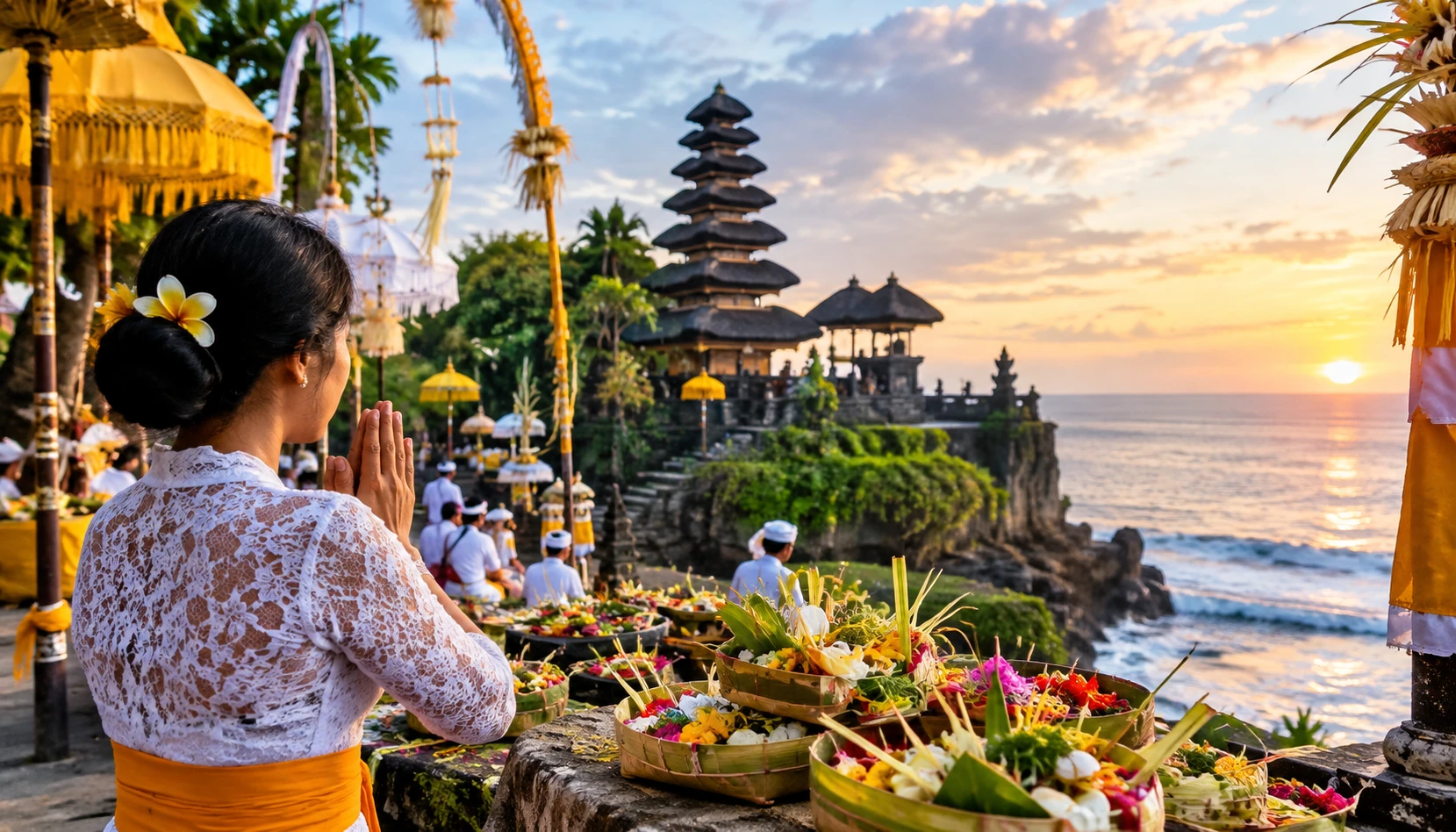
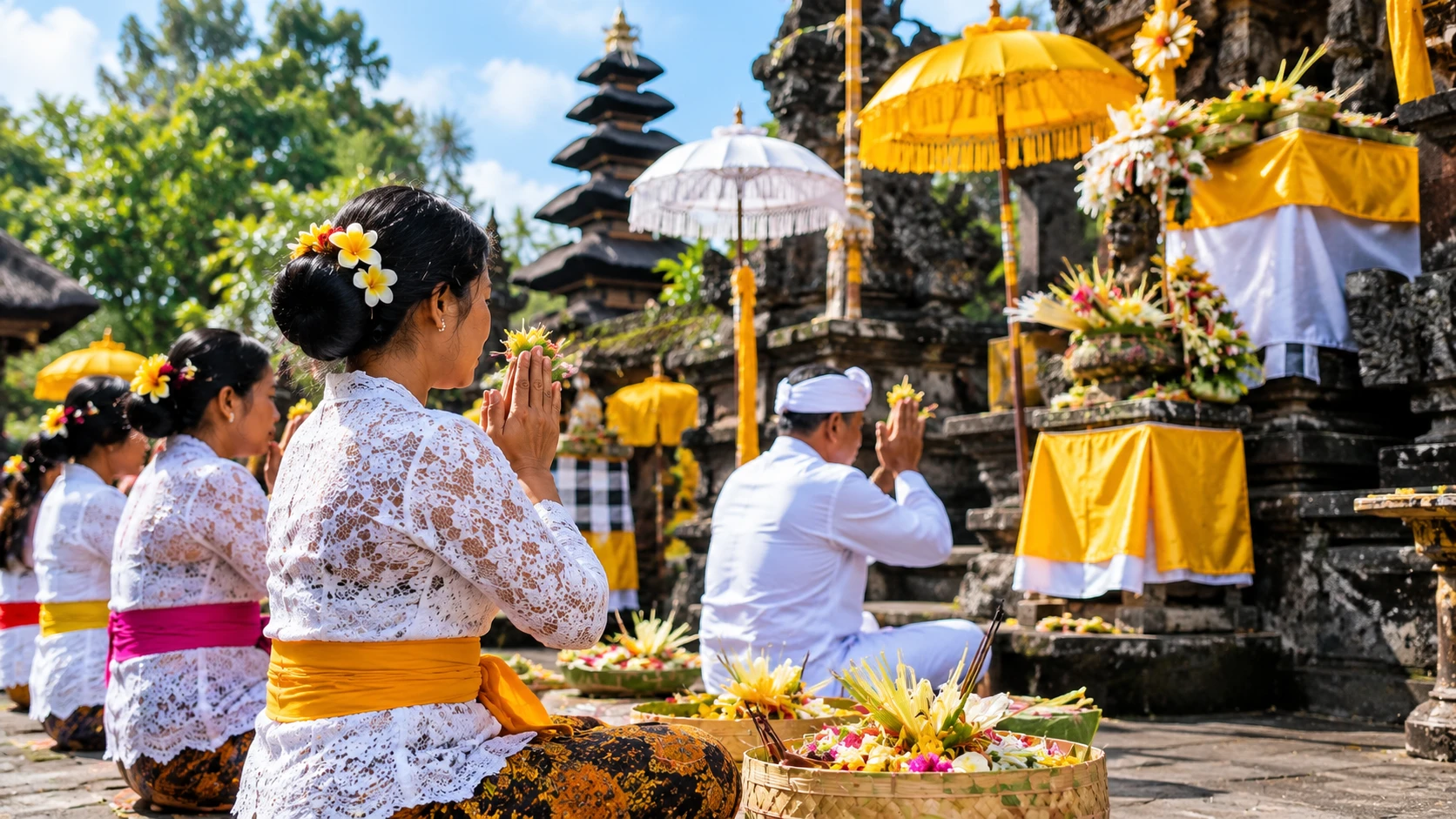
Prayer is not limited to a weekly service. Offerings may be placed at the family shrine, the gate, a workplace and other meaningful points. Incense, flowers and small portions of food become part of the daily landscape.
For a newcomer, Balinese daily life becomes easier to understand when these acts are seen as ordinary household responsibilities. Respecting small rituals matters more than knowing every theological term. A shopkeeper pausing for prayer is attending to a routine duty.
The table separates everyday actions from the larger ceremonies that visitors are likely to notice. Times and access rules vary by village and temple, so the categories are a guide rather than a fixed schedule.
Ask locally before joining a ritual. Some events welcome observers, while others are intended for family members or worshippers only.
| Practice | What you may see | Typical timing |
|---|---|---|
| Daily offerings | Canang sari at homes and shops | Daily or frequently |
| Family rites | Birth, marriage and ancestral observances | At life milestones |
| Temple anniversaries | Odalan, offerings and processions | Often on the 210-day cycle |
| Major holidays | Nyepi, Galungan and Kuningan | According to Balinese calendars |
| Purification | Melukat at appropriate sacred sites | According to individual practice |
Tri Hita Karana is commonly explained through three relationships: with the divine, with other people and with the natural environment. It connects prayer, community cooperation and care for land and water within one framework.
The philosophy is visible in practical decisions. Shared irrigation, collective temple maintenance and neighborhood ceremonies are treated as connected responsibilities rather than separate activities. It helps explain why a ritual can involve an entire street.
Canang sari are small arrangements, often made from woven palm leaves with flowers and incense. They may sit on steps, pavements, shrines or shop counters. Their purpose is devotional, even when they look decorative to an outsider.
Do not step on or move an offering deliberately. If one is placed in a doorway, walk around it where possible. Avoid treating the arrangement as a prop for photographs, especially when someone is preparing or presenting it.
Traditional family compounds commonly include a sacred area used for prayers and ancestral rites. Its placement follows local ideas about orientation and purity. Even homes outside older compounds may maintain a shrine.
A family temple is private religious space, not an attraction. A guest should wait for an invitation before entering or photographing it. For residents renting nearby, morning offerings and family gatherings are normal parts of the local soundscape.
Balinese villages often maintain temples with different ceremonial roles, while major sanctuaries attract worshippers from across the island. Temple compounds typically have several courtyards, with access becoming more restricted toward the sacred inner area.
The Bali temple guide explains how these spaces are organized. An admission ticket does not grant access to every courtyard or ceremony. Follow signs and the instructions of temple attendants even when other tourists are moving ahead.
Mount Agung is a major sacred reference point in Balinese religious geography. Orientation toward the mountains and away from the sea influences the arrangement of temples and traditional compounds. The Besakih temple complex stands on its slopes.
The mountain is more than a scenic backdrop. Its place in local orientation helps explain why shrines, processions and ceremonial spaces may face particular directions. These choices are meaningful to worshippers even when they are invisible to visitors.
A banjar is a neighborhood community organization that coordinates collective tasks, including ceremonies and mutual assistance. Its responsibilities can involve preparing offerings, arranging processions, maintaining communal spaces and helping families during major life events.
A ceremony can affect the whole neighborhood. Residents may see temporary road closures, shared preparations and changes in staff availability. Asking the local community about upcoming events is often more useful than relying on a general tourist calendar.
Nyepi marks the Balinese Saka New Year through a day of stillness and reflection. Public activity stops across the island, including ordinary road travel and airport operations. Residents and visitors are expected to respect local restrictions, with specific arrangements for emergencies.
Plan supplies and transport before Nyepi begins. Accommodation providers can explain the rules that apply to guests. The quiet day is preceded by lively preparations in many areas, making the contrast particularly striking.
Galungan and Kuningan are major observances connected with dharma and ancestral spirits. Tall decorated bamboo poles, called penjor, appear along streets, and families visit temples and relatives. Kuningan follows Galungan ten days later.
The dates follow the Balinese calendar rather than a fixed Gregorian date. Check Balinese holidays when arranging a trip. Expect changes in traffic and business hours during important family celebrations. Avoid scheduling essential appointments without confirmation.
Each temple has its own anniversary observance, often called odalan. Many follow the 210-day Pawukon cycle, so celebrations take place somewhere on the island throughout the year. Preparation may involve offerings, music, decorations and several days of communal work.
A local temple anniversary can matter more to your street than an island-wide holiday. If you are staying near a temple, ask about its next odalan. You may enjoy the ceremony while still needing an alternative driving route.
Melukat refers to purification practices involving water, prayer and prescribed sequences. Some water temples welcome visitors to participate under guidance; others have more restricted conditions. Not every spring or pool is suitable for a casual ritual.
Ask an attendant about the correct sequence and permitted areas. Wear the required clothing and do not assume that following another visitor is sufficient. Respectful participation begins with understanding that the site is a place of worship.
Balinese families mark important transitions through rites associated with infancy, coming of age, marriage and death. An otonan observance follows the 210-day calendar, while tooth-filing ceremonies have a distinct place in coming-of-age traditions.
These events belong to families, not a visitor timetable. Invitations are personal, and customs vary. If you attend as a guest, ask what to wear, where to sit and whether photography is welcome before the ceremony starts.
Ngaben is a cremation rite connected with the soul's journey and the release of the body’s elements. Ceremonies can be elaborate and may involve processions, decorated structures and community participation. Timing and scale depend on family circumstances and local practice.
Treat a funeral procession as a solemn event. Give participants space, do not block the route for a photograph and follow local instructions. The presence of music or colorful structures does not make the occasion a tourist performance.
Gamelan ensembles accompany many ceremonies, and certain dance forms have devotional roles. Other performances are presented for public audiences. The same artistic tradition can therefore appear in both sacred and staged settings.
A guide to traditional Balinese dances helps distinguish those contexts. A ticketed show and a temple offering are not interchangeable. Watch respectfully and avoid entering a ritual area simply to get a better view of the performers.
Temple rules often require a sarong and sash, and access may be limited during ceremonies. Dress modestly, avoid climbing on sacred structures, and keep a respectful distance from people praying. Some temples also display additional customary restrictions at the entrance.
Follow the rules posted at that specific temple. Ask before taking close-up photographs, and never cross a barrier into the inner sanctuary. The appropriate response to uncertainty is to check with a local attendant rather than copy another tourist.
For people living on Bali, religious observances influence traffic, work schedules, construction and the use of public space. A neighborhood may be quiet most days and busy before a temple festival. Staff may need time for family or banjar responsibilities.
Check the calendar and the immediate surroundings before choosing a home. Ask whether a nearby temple hosts frequent events, whether access roads close and how neighbors coordinate ceremonies. These are features of community life, not signs that a district is poorly managed.
Is Bali a Hindu or Muslim island?
Bali is predominantly Hindu, while Indonesia as a whole has a Muslim-majority population. Bali also has Muslim, Christian and Buddhist communities.
What religion do most Balinese people practice?
Most ethnic Balinese practice Balinese Hinduism, often called Agama Hindu Dharma, which incorporates local ritual traditions and ancestor reverence.
Can tourists enter Hindu temples on Bali?
Many temples allow visitors in designated areas with appropriate clothing. Inner sanctuaries and some ceremonies remain restricted.
Why are offerings placed on Bali’s streets?
Small offerings such as canang sari are part of daily devotion and gratitude. They may be placed at homes, shops and shrines.
Does religion affect travel around Bali?
Yes. Nyepi imposes major island-wide restrictions, while local temple festivals and processions can temporarily change traffic and opening hours.
DDA Real Estate helps compare homes on Bali with attention to neighborhood routines, access roads and the practical details of living near local communities.
Explore our properties in Bali and leave an enquiry: share your preferred area and living priorities so we can prepare a focused selection of homes.