Off-plan properties
The line that surprises foreign owners is not electricity or gas. It is aidat — the building maintenance fee — which ranges from 500 to over 10,000 lira a month and can exceed every other utility combined.
All in, a three-bedroom apartment costs 4,000 to 15,000 lira monthly to run, and the spread comes almost entirely from the building rather than from the family living in it. A basic block in Antalya sits at the bottom; a complex with pool, gym and round-the-clock security in Istanbul sits at the top.
This guide covers the eight cost categories, typical 2026 figures by city, how connections are set up and where foreign buyers are most often caught out. Figures reflect current tariffs and are indicative — verify with providers and the building management before committing.
Four are consumption-based and vary with how you live; four are fixed and vary with what you bought.
| Category | Frequency | Three-bedroom, 100 m² | Note |
|---|---|---|---|
| Electricity | Monthly | 800 – 2,500 TRY | Tiered rates, regional monopoly |
| Water | Monthly | 200 – 600 TRY | Municipal supplier |
| Natural gas | Monthly in winter | 400 – 2,000 TRY | Effectively zero in summer |
| Internet | Monthly | 400 – 800 TRY | 100 Mbps fibre |
| Aidat | Monthly | 500 – 3,000+ TRY | Depends entirely on amenities |
| Property tax | Twice yearly | 500 – 3,000 TRY a year | Due in May and November |
| Earthquake insurance | Annual | 500 – 1,500 TRY a year | Mandatory |
| Waste and road levy | Quarterly | Usually inside aidat | Municipal |
Three figures are worth holding on to. An empty apartment still costs 1,500–4,000 lira a month in standing charges and fixed fees. Occupied normally, the same unit runs 4,000–7,500. A luxury complex in Istanbul or Bodrum reaches 8,000–18,000 — and the difference is almost entirely aidat.
Seasonality adds a further swing: gas heating adds 1,500–3,000 lira a month from November to March, and air conditioning can double the electricity bill in July and August on the coast.
Distribution is a regional monopoly — different companies serve Istanbul’s European and Asian sides, Ankara, the Aegean and the Mediterranean, and you cannot switch. The only variable you control is consumption.
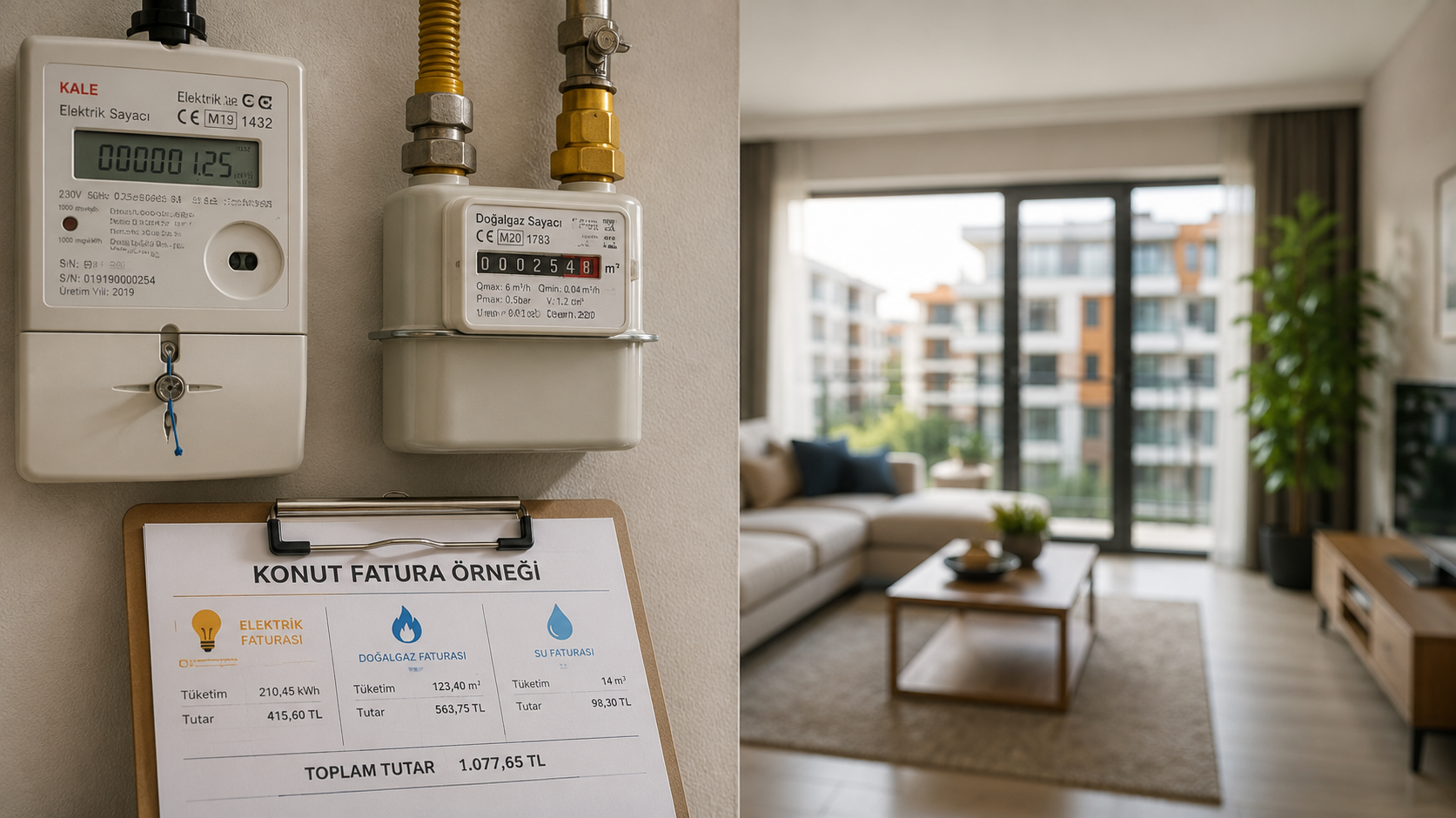
Residential tariffs are tiered: the first 210 kilowatt-hours a month bill at a reduced rate, everything above at a substantially higher one. A three-bedroom apartment uses 200–400 kilowatt-hours as a baseline, 400–800 in summer with air conditioning, and 500–1,000 or more in winter if heating is electric.
| Season | With gas heating | With electric heating only |
|---|---|---|
| Spring and autumn | 800 – 1,500 TRY | Same |
| Summer with air conditioning | 1,500 – 3,500 TRY | Same |
| Winter | 1,500 – 2,500 TRY | 3,000 – 6,000 TRY |
That bottom-right figure is the one to watch when buying. An apartment without a gas connection costs roughly twice as much to heat, and the difference over a winter exceeds a year of aidat in a mid-range building.
Water is the smallest line on the bill and the least worth optimising. Each city has its own municipal utility, rates are tiered with the first ten cubic metres subsidised, and a family of three or four uses 15–25 cubic metres a month for 200–600 lira. Coastal cities charge slightly more than inland ones because of infrastructure costs.
Tap water is chlorinated and technically safe in most cities but rarely drunk; bottled delivery of nineteen-litre jugs at 25–40 lira is the norm and belongs in the budget.
Gas is a different matter, because it is both the largest winter cost and the one most often missing. The grid covers major cities and their suburbs; rural areas and some newer developments outside it rely on bottled gas or electricity.
Verify the gas connection before purchase, not after. Retrofitting an unconnected apartment costs 3,000–8,000 lira for the infrastructure connection plus 500–1,500 for the meter, and the process is slow. Winter bills with heating run 1,500–3,500 lira a month from November to March; if gas serves only heating and not hot water, summer bills fall to a nominal standing charge.
Most buildings use an individual combi boiler per apartment. Older stock may run a building-wide system with the cost distributed through aidat, which removes your control over the setting and the bill.
The one category with genuine competition, and the only one where switching provider is worth doing.
Fibre at 100 megabits costs 400–600 lira a month in urban Istanbul, Ankara, Izmir and Antalya; 250 megabits runs 600–800 and a gigabit 900–1,200. Rural areas remain on slower copper connections. Installation is free with a twelve to twenty-four month contract, or 300–700 lira standalone.
Two practical notes for foreign owners: English-language customer service is available from some providers in major cities but not all, and bundling home internet with a mobile plan usually costs less than buying them separately. Contracts lock in for a year or two, with early termination costing one to three months of subscription.
This is the fee charged by the building’s residents’ association for shared expenses — lifts, cleaning, security, common-area electricity, gardening, the doorman, and any pool, gym or sauna the complex carries.
| Building type | Monthly aidat | What it covers |
|---|---|---|
| Basic four-storey block | 300 – 800 TRY | Lift and cleaning |
| Mid-range with doorman | 800 – 2,000 TRY | Adds staffing and grounds |
| Luxury complex | 3,000 – 10,000+ TRY | Pool, gym, 24-hour security, landscaping |
On a 200,000-dollar apartment, aidat of 5,000 lira a month is a meaningful share of the yield. For a rental investment this can be the difference between a working asset and a slow bleed, and it is set by the building rather than by the market — which means it is checkable in advance and often is not checked.
Two fixed annual costs, both modest in absolute terms and both capable of causing trouble if ignored.
Property tax
Charged on the assessed tax value, which typically sits at 20–40% of market value. The rate is 0.1% in ordinary municipalities and 0.2% in metropolitan ones, doubling for commercial property, with an additional levy on high-value residential.
For a three-bedroom apartment that means 500–3,000 lira a year in mid-range areas and 3,000–8,000 in prime Istanbul or Antalya districts, payable in two instalments in May and November with a modest discount for paying in full early.
One point deserves attention in 2026: assessed values are reassessed on a four-year cycle, and a new cycle has begun for many cities. Expect the base to rise even though the rate has not changed. Where a formal valuation is needed for the transaction itself, the process is set out in our guide to appraisal reports in Turkey.
Earthquake insurance
Mandatory for all residential property, covering structural damage from earthquake and the fires, tsunamis, landslides and floods that follow one. Premiums for a three-bedroom apartment run 500–1,500 lira a year, higher in high-risk zones including the Marmara region.
It is required for title transfer, for utility connections and for sale, so lapsing creates practical problems long before it creates a coverage gap. Cover is capped, and it protects the structure only — contents, theft, water damage and liability need separate voluntary cover at 800–3,000 lira a year. What each policy does and does not include is set out in our guide to property insurance in Turkey.
Consumption barely moves between cities. Aidat and tax do, and they set the total.
| City | Electricity | Aidat, mid-range | Property tax a year | All-in monthly |
|---|---|---|---|---|
| Mersin | 800 – 1,700 TRY | 600 – 1,500 TRY | 500 – 1,500 TRY | 3,000 – 5,500 TRY |
| Antalya | 900 – 2,200 TRY | 800 – 2,000 TRY | 1,000 – 2,000 TRY | 3,500 – 7,000 TRY |
| Izmir | 900 – 2,000 TRY | 900 – 2,200 TRY | 1,100 – 2,200 TRY | 3,700 – 7,200 TRY |
| Ankara | 800 – 1,800 TRY | 1,000 – 2,500 TRY | 1,200 – 2,500 TRY | 4,000 – 7,500 TRY |
| Istanbul | 1,000 – 2,500 TRY | 1,500 – 4,000 TRY | 1,500 – 3,000 TRY | 5,500 – 10,000 TRY |
| Bodrum | 900 – 2,500 TRY | 2,000 – 6,000+ TRY | 1,500 – 4,000 TRY | 5,000 – 12,000+ TRY |
The gap between the cheapest and dearest city is roughly threefold, and aidat explains most of it. Bodrum carries the highest maintenance fees in the country because the stock is concentrated in complexes with pools, gardens and marina access. Mersin sits at the other end and has become a value destination for that reason — the wider picture of the city is covered in our guide to Mersin.
Ankara has the highest winter gas consumption thanks to a colder climate; Izmir sits mid-range across the board with slightly higher water charges, and what living there is actually like is covered in our guide to Izmir for expats.
The sequence matters, because each step depends on the one before it.
Allow one to three weeks from title transfer to everything being live, assuming the documents are ready.
Most of the bill is fixed by the building and the region. Four things genuinely move the number.
The largest saving is not on this list, because it happens before purchase. Choosing a building with modest amenities over one with a pool and a gym changes the monthly figure more than every efficiency measure combined, and it is a decision that can only be made once.
What does a three-bedroom in Antalya really cost to run?
Around 4,000–6,500 lira a month all in for a mid-range apartment occupied full time: roughly 1,000–1,800 for electricity, 300–500 water, 500–1,500 gas in winter, 500 internet, 1,000–1,500 aidat, plus tax and insurance apportioned monthly.
Which bill rises most in a luxury complex?
Aidat, by a wide margin. A mid-range building charges 1,200–2,000 lira; the same-sized unit in a complex with pool, gym and security can reach 5,000–10,000 — more than all other utilities combined.
Do I pay aidat on an empty apartment?
Yes. The obligation follows ownership, not occupancy. Some buildings grant a reduced rate of 50–70% for verified empty units, but it requires board approval and is not standard.
Can I set up utilities without a residence permit?
Yes, if you own the property — the title deed and tax number are sufficient. Tenants need either a residence permit or the landlord’s cooperation.
What happens if earthquake insurance lapses?
Utilities cannot be transferred or renewed, the property cannot be sold, and any claim would be void. Renewal costs 500–1,500 lira a year, so the compliance value far exceeds the premium.
Do utilities transfer when I sell?
No. The seller closes the accounts and the buyer opens new ones, with meter readings taken at handover and final bills settled by the seller. Allow one to two weeks for the transition.
Pre-paid or post-paid meters?
Post-paid suits owners: better rate structure, no unexpected cut-offs and direct debit available. Pre-paid suits landlords because it limits exposure to tenant debt. Switching costs 500–1,000 lira through the provider.
The purchase price is negotiated once; the running cost is paid every month for as long as you own the property. And unlike the price, it is knowable in advance — six months of aidat billing, a management plan and a look at the heating setup answer most of it in an afternoon. DDA Real Estate is a real estate agency in Turkey. We work across Antalya, Alanya, Istanbul, Bodrum and Mersin, and we pull aidat history and building documents before an offer rather than after, so the monthly figure is part of the decision rather than a discovery.
Explore our offers in Turkey and get in touch: we will model the full running cost of any property you are considering, flag where the building is carrying charges you would not want, and set out what the same budget buys with lower maintenance. For buyers weighing Turkey as a long-term base, our guide to retiring in Turkey covers the wider cost picture.